

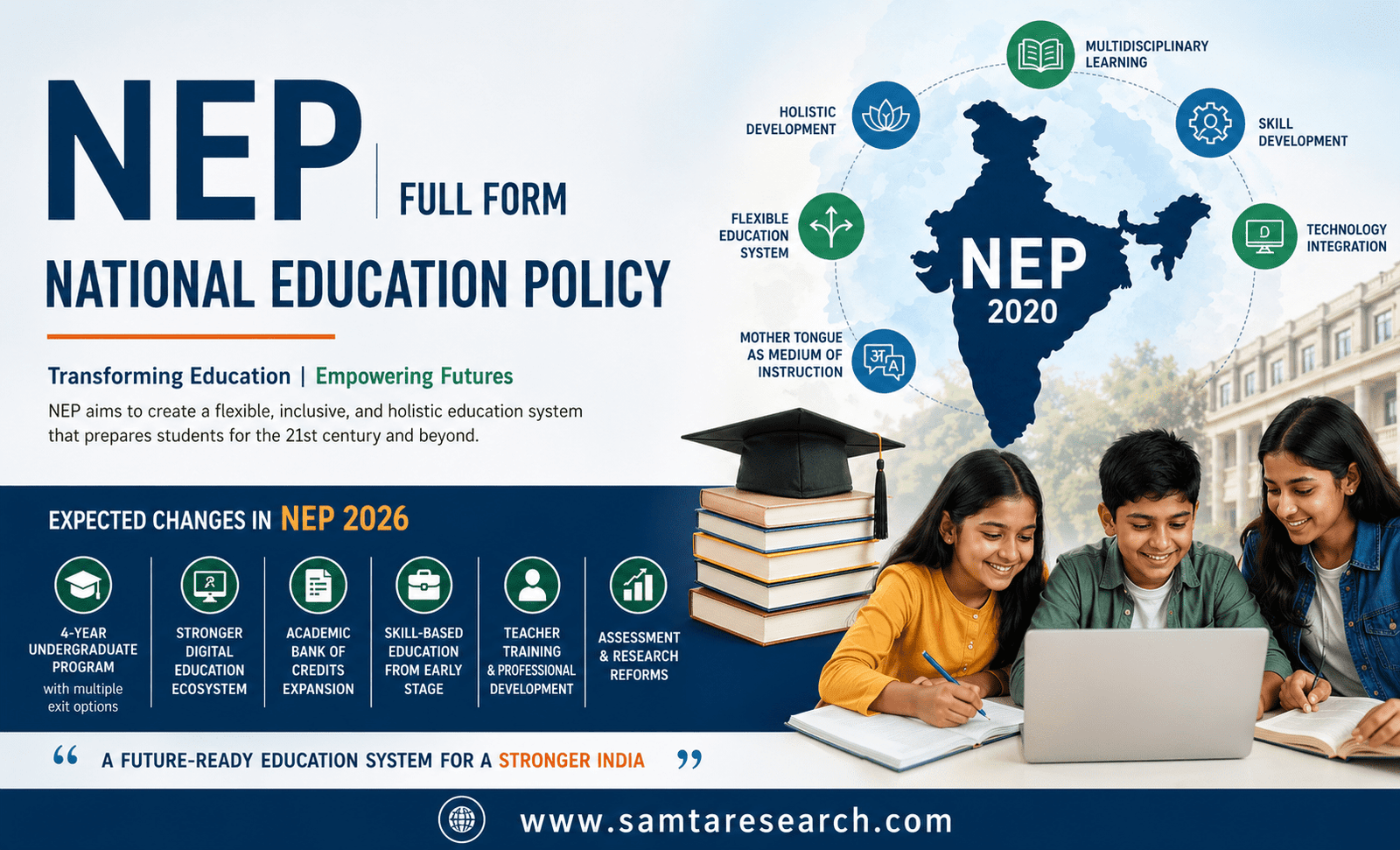
Education is the driving force behind a nation’s development, and India is making significant strides in revolutionising its education system with the National Education Policy (NEP). If you are wondering what NEP means, it’s the National Education Policy. Launched in 2020, NEP seeks to transform the conventional education system to make it more holistic, adaptable and globally relevant.
Let’s explore what NEP stands for, its key elements and what NEP 2026 will bring.
The Government of India launched it in 2020 to enhance the education sector to be more flexible, skill-oriented and multidisciplinary.
Table of Contents
ToggleKey Features of NEP 2020
To comprehend what we might expect in the future, we need to first understand the changes brought about by NEP 2020:
- New School Structure (5+3+3+4 System)
It has replaced the 10+2 system with the following structure:
- Foundational stage (5 years)
- Preparatory stage (3 years)
- Middle stage (3 years)
- Secondary stage (4 years)
- Focus on Early Childhood Education
NEP stresses the importance of early years’ education ensuring children from 3-6 years of age are well educated.
- Multidisciplinary Learning
They can select subjects from different streams. A science student can choose to study music or arts, for instance.
- Vocation and Skill Development
Early on, practical skills are taught, increasing employability. - Mother Tongue as Medium of Instruction
NEP promotes mother tongue-based instruction, particularly in elementary school.
- Technology Integration
Online learning, digital education and application of AI are encouraged.
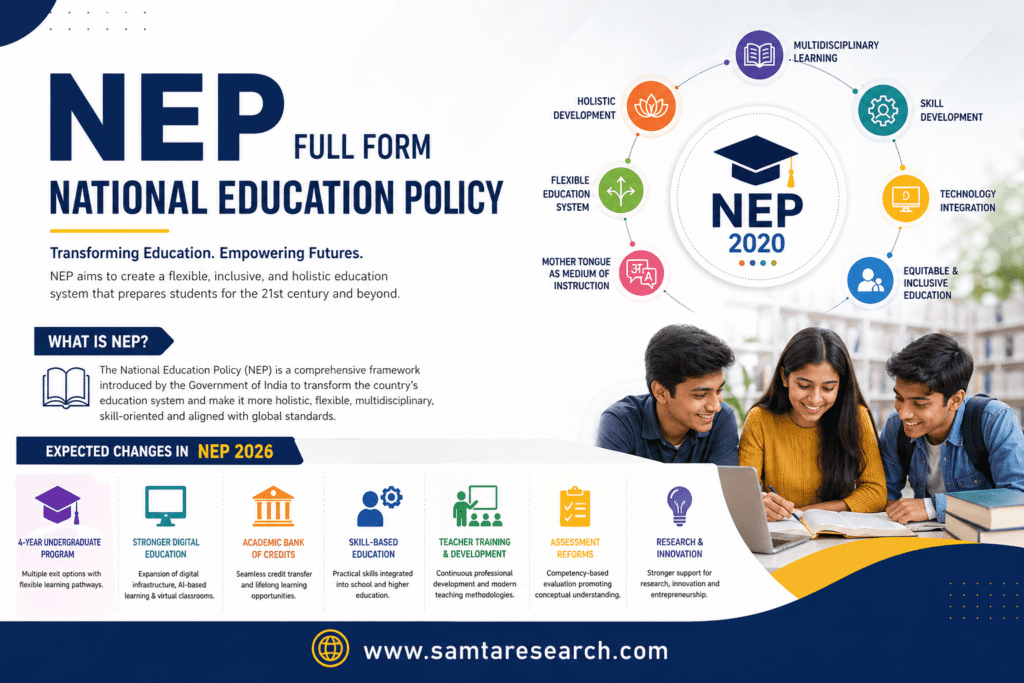
Why NEP is Important for India
Indian education has been accused of being too rote and “exam-focused”.
NEP aims to do this by:
- Promoting conceptual understanding over memorization
- Encouraging innovation and creativity
- Bridging the gap between education and employability
- Making education accessible to all sections of society
This shift is crucial for preparing students for a rapidly changing global economy.
What Will Change in NEP 2026
NEP 2020 provided the framework, but the next few years, particularly 2026, are likely to see enhanced implementation and fine-tuning. Here are some key changes anticipated:
- 4-Year Undergraduate Program Fully Integrated
Most universities will have flexible 4-year undergraduate degrees by 2026. Students can:
- After 1 year, with a certificate
- Exit after 2 years with a diploma
- Exit after 3 or 4 years with a degree
This alleviates drop-out rates and facilitates various career options.
- Stronger Digital Education Ecosystem
NEP 2026 is likely to boost digital infrastructure:
- Virtual classrooms
- AI-based personalized learning
- More SWAYAM-like platforms
This will improve access to education, particularly in rural India.
- Expansion of the National Credit Bank System
The Academic Bank of Credits (ABC) will most likely be fully operational in this year, enabling students to carry their electronic academic credits. This means:
- More mobility between courses or institutions.
- Lifelong learning opportunities
- Greater Emphasis on Skills
Vocation education could be integral to school curriculum by 2026. Children might learn practical skills such as programming, entrepreneurship or design thinking early in their education.
- Teacher Training and Development
NEP 2026 will likely improve teacher training programs:
- Mandatory professional development
- Use of new teaching techniques
- Use of technology in classrooms
Good teachers mean good students
- Assessment Reforms
Tests are likely to be less daunting and more competency-focused. Tests will focus upon:
- Understanding
- Application of knowledge
- Problem-solving skills
- More Focus on Research and Innovation
Universities may get funding and research grants from institutions such as the National Research Foundation (NRF). This will make India a knowledge society.
Challenges in Implementing NEP
The aspirations are high but the realities difficult. These include:
- Rural infrastructure needs
- Teacher training requirements
- Digital divide among students
- Central and state government coordination
Overcoming such problems will be essential to the success of NEP 2026.
Conclusion
Knowing the NEP full form – National Education policy – is only the start. NEP marks a paradigm shift in India’s education, from rote to flexible, skill-based and student-friendly learning. As we head into 2026, the emphasis will be on implementation, technology and building an empowered student. With successful implementation, NEP will transform and globalise education in India. It will be crucial for students, teachers, and educational institutions to keep up to date and embrace the changes. India’s future of education is not about learning, it’s about evolving. For more this type of knowledge do not forget to visit our website: Samta Research Alliance
FAQs ( Frequently Asked Questions )
NEP is the National Education Policy.
NEP was launched in 2020.
To provide flexible, skill-focused and student-friendly education.
Multidisciplinary degrees, online learning, skill-based and better assessment.
