

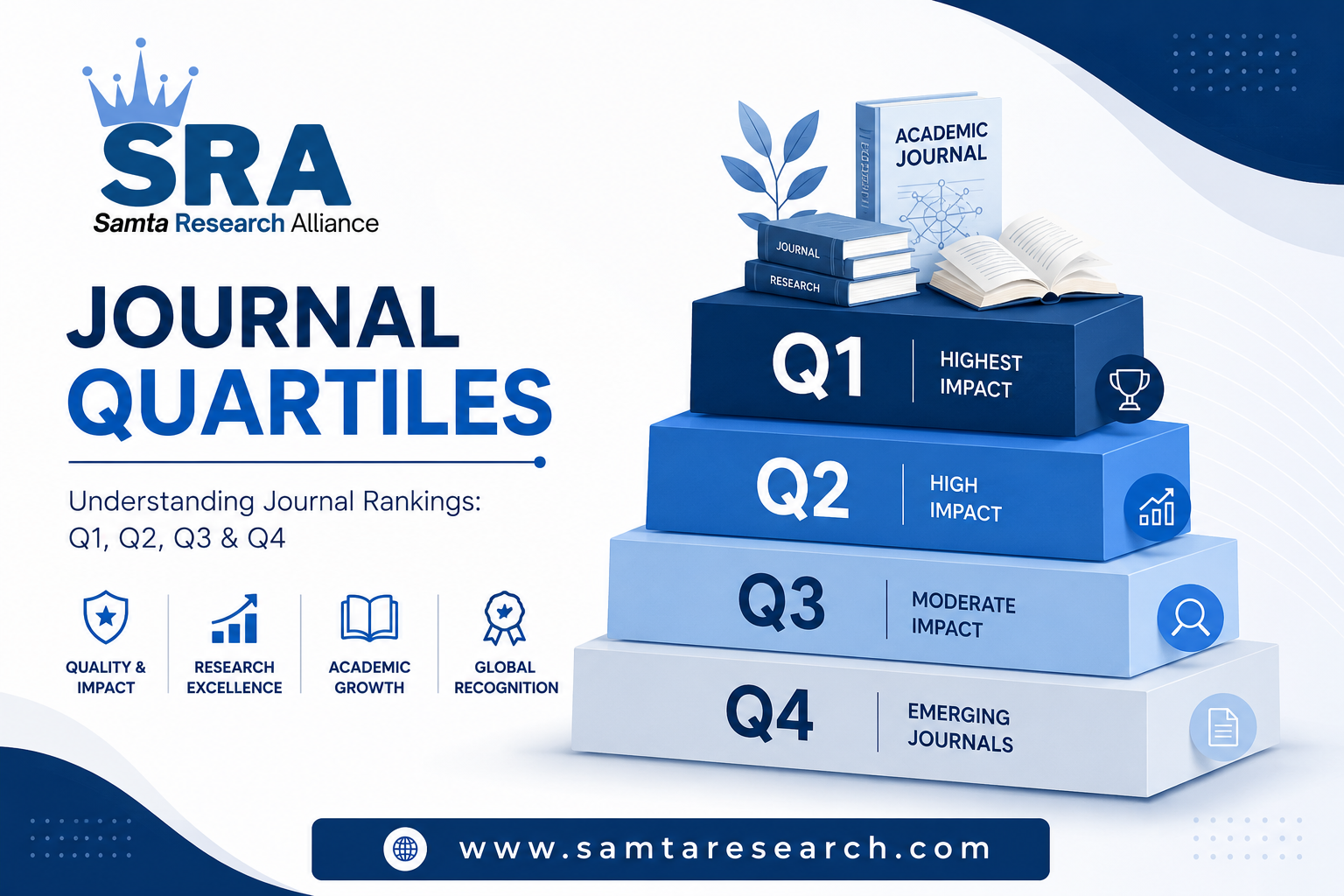
As a PhD scholar, research student or an academic who's just preparing to publish their first paper, you have encountered the term Q1 journal, Q2 journal, or the general term Q1 Q2 Q3 Q4 journal. It's a phrase that is often used by supervisors, universities and funding agencies when talking about the expectation of dissertation writers to publish in a "good quartile" journal, but it's rarely defined.
Quick answer: A Q1, Q2, Q3 or Q4 journal is a ranking of academic journals within their subject area, with the top 25% (highest impact) being labeled Q1, the next 25% Q2, the following 25% Q3 and the bottom 25% Q4. The rankings are based on SCImago (SJR) or Journal Citation Reports (JCR) and revised annually.
This guide explains what is meant by “Q1 Q2 Q3 Q4” journal ranking, how it is determined, why it is important to your academic career to know whether your paper goes in a Q1 or Q2 journal, and how you can know which journal quartile is the right one before submitting your next paper.
Table of Contents
ToggleWhat Does Journal Quartile (Q1, Q2, Q3, Q4) Mean?
Journal rank is a system of ranking academic journals within a specific subject area into four equal parts according to their citation impact and influence in that subject area. Imagine it is a performance ladder:
- Q1 Journal – The top 25% of journals for the subject category (highest impact, highest prestige)
- Q2 Journal – Next 25% (50th - 75th percentile) – strong, well regarded journals
- Q3 Journal – Next 25% (25th – 50th percentile): moderate impact.
- Q4 Journal – Middle 25% — middle citation impact in the category
So if you hear about a Q1 Q2 Q3 Q4 journal system, you are hearing about this four-tier ranking that enables researchers, universities, and hiring committees to easily evaluate the credibility and reach of a journal — without reading all of the articles published in that journal.
How Are Journal Quartiles Calculated?
The Journal Quartiles are not assigned at random. These are computed based on the citation-based metrics from two major databases:
- Scopus (via SCImago Journal Rank – SJR) SCIMago ranks journals by quartile using an average prestige per article in a journal, weighted by the influence of the citing journals (SCImago Journal Rank – SJR). The quartile rankings by subject categories and by year are published free and publicly searchable by SCImago.
- Web of Science (via Journal Citation Reports – JCR) JCR (also known as Web of Science) Clarivate have decided to use the Journal Impact Factor (JIF), a measure of the average number of citations articles receive in the previous two years, ranked within its subject category.
A journal may be ranked Q1 for one subject category and Q2 or Q3 for another, depending on the subject category and the competition for it. Look at the quartile of the journal, not the specific topic area in which you are researching.
Q1 vs Q2 vs Q3 vs Q4 Journals — Key Differences
Aspect | Q1 Journal | Q2 Journal | Q3 Journal | Q4 Journal |
Ranking position | Top 25% | 50–75th percentile | 25–50th percentile | Bottom 25% |
Citation impact | Highest | High | Moderate | Lower |
Acceptance rate | Usually low (highly competitive) | Moderate | Comparatively easier | Easiest |
Review process | Rigorous, multiple rounds | Rigorous | Standard | Standard/faster |
Academic value | Highest for PhD/UGC/NIRF recognition | Strong, widely accepted | Acceptable for many requirements | Use with caution |
Why Q1 and Q2 Journals Matter for PhD Scholars
Going through Q1 and Q2 journals is not all about prestige, it is also about having tangible effects on your academic journey:
- UGC and university mandates: Some Universities and UGC in India require that the PhD scholars publish at least one paper in a Scopus/Web of Science indexed Q1 or Q2 journal before the submission of their thesis.
- Career and funding impact: The quartile of publications is also a critical factor in career and funding decisions such as fellowships, postdoctoral opportunities, and research proposals.
- Credibility and visibility: If you publish in Q1, it will get read, cited, and referenced by other researchers and thus give your academic profile more credibility and increase your citation index (h-index).
- Avoiding predatory journals: The quartile system will also help you identify predatory journals, which bear the name of legitimate journals but are not actually impactful to the academic community and can do serious harm to your academic reputation.
In other words, a paper in a Q1 journal has more academic credibility than the same paper published in a Q3 or Q4 journal, even though both may be "peer reviewed.
How to Check If a Journal is Q1, Q2, Q3, or Q4
Prior to manuscript submission, authors should check the quartile of the journal using one of the following free and reliable sources:
- SCImago Journal Rank (SJR) – Search the journal name and then by year and by subject category to see its exact quartile.
- Journal Citation Reports (JCR) – When your institution subscribes, JCR provides you with Impact Factor-based quartiles from the Clarivate/Web of Science.
- Journal's official website – You can find the current quartile and impact factor of the journal on the "About" or "Indexing" page in the official website of the journal.
- Scopus Sources list – Check if the journal is Scopus-indexed in the Scopus Sources list and before making any quartile statements.
Please check quartile data for the current year as quartiles will be recalculated each year and the quartiles of a journal may change.
Tips for Publishing in Q1 and Q2 Journals
- Choose your subject category carefully — Pick a subject area that you think won't be too competitive for Q1 — it can be a niche or interdisciplinary.
- Study 3–5 recent papers: Read 3-5 papers in the past few years from your target journal, and copy its style and structure, as well as the level of methodological development.
- Prioritize originality and strong data analysis — Originality and good data analysis are paramount — Q1/Q2 readers are very critical of originality and statistical rigor.
- Follow author guidelines exactly — Always adhere to the author's style and instructions; one of the most frequent rejections (and avoidable) is desk rejection due to formatting.
- Get expert review before submission — a second set of experienced eyes will be able to pick up on any missing elements in methodology, language, or structure which could result in rejection.
Tips for Publishing in Q1 and Q2 Journals
A Q1 journal is one of the top 25% of the journals in its specific subject field that is measured using citation impact metrics from SCImago (SJR) or Journal Citation Reports (JCR). It is the most highly regarded academic level of trust in that area.
The Q1 journals are among the 25% most cited journals in their respective disciplines and the Q2 journals in the 50th–75th percentile. The Q1 journals are more competitive, more rigorously reviewed and have more academic significance than Q2 journals.
The four quartiles (Q1, Q2, Q3, Q4) are used to classify journals within a subject category in order of impact (from highest to lowest). Citation data from SCImago or JCR is used for this classification.
Yes. Most universities and UGC guidelines consider Q1 or Q2 Scopus/Web of Science indexed journals as fulfilling the requirement for publication in PhD journals, but the Q1 journals are mostly preferred for fellowships and academic positions.
Use the SCImago Journal Rank (SJR) website or Journal Citation Reports (JCR) to search for the journal's name and look at its quartile for the particular subject category and year of the journal's study.
Yes. Note that the quartile rankings are subject category specific; that is, a journal may have different rankings in the various categories in which it is indexed.
Conclusion
Knowing what is Q1 Q2 Q3 Q4 journal ranking is one of the most crucial steps in the process of a successful academic publication strategy. When you're thinking of submitting to a journal for your university's PhD or you're considering Q1 and Q2, always double check through SCImago or JCR.
In Samta Research Alliance, we assist PhD scholars and researchers to find the most suited journal, improve their manuscripts, and make them through to Q1 and Q2 indexed journals and guide them on the journal submission and publication process. For expert advice on choosing the right journal and/or publishing assistance, please contact us now.
